
The technology
How a Leveluk ionizer works.
A Leveluk connects to your kitchen tap, filters what passes through it, runs that water across electrode plates in an electrolysis chamber, and delivers the setting you chose at the panel. This page walks through each stage, the parts that do the work, what hydrogen-rich water means, and the five water types — two for drinking, three not.
The machine
What a water ionizer is.
A water ionizer is a countertop appliance that stands beside the sink and connects to the tap. It filters the water passing through it, then uses a controlled electric current to separate that filtered water into two streams — one alkaline, one acidic — and lets you choose which one comes out.
That is a different job from a filter jug, which only filters, and from a bottle or a tablet, which adds gas to water that has already been poured. An ionizer does both jobs at the tap, while the water runs.
Enagic’s ionizers are the Leveluk series. All three produce the same five water types; what separates them is electrode plates, capacity and the panel.
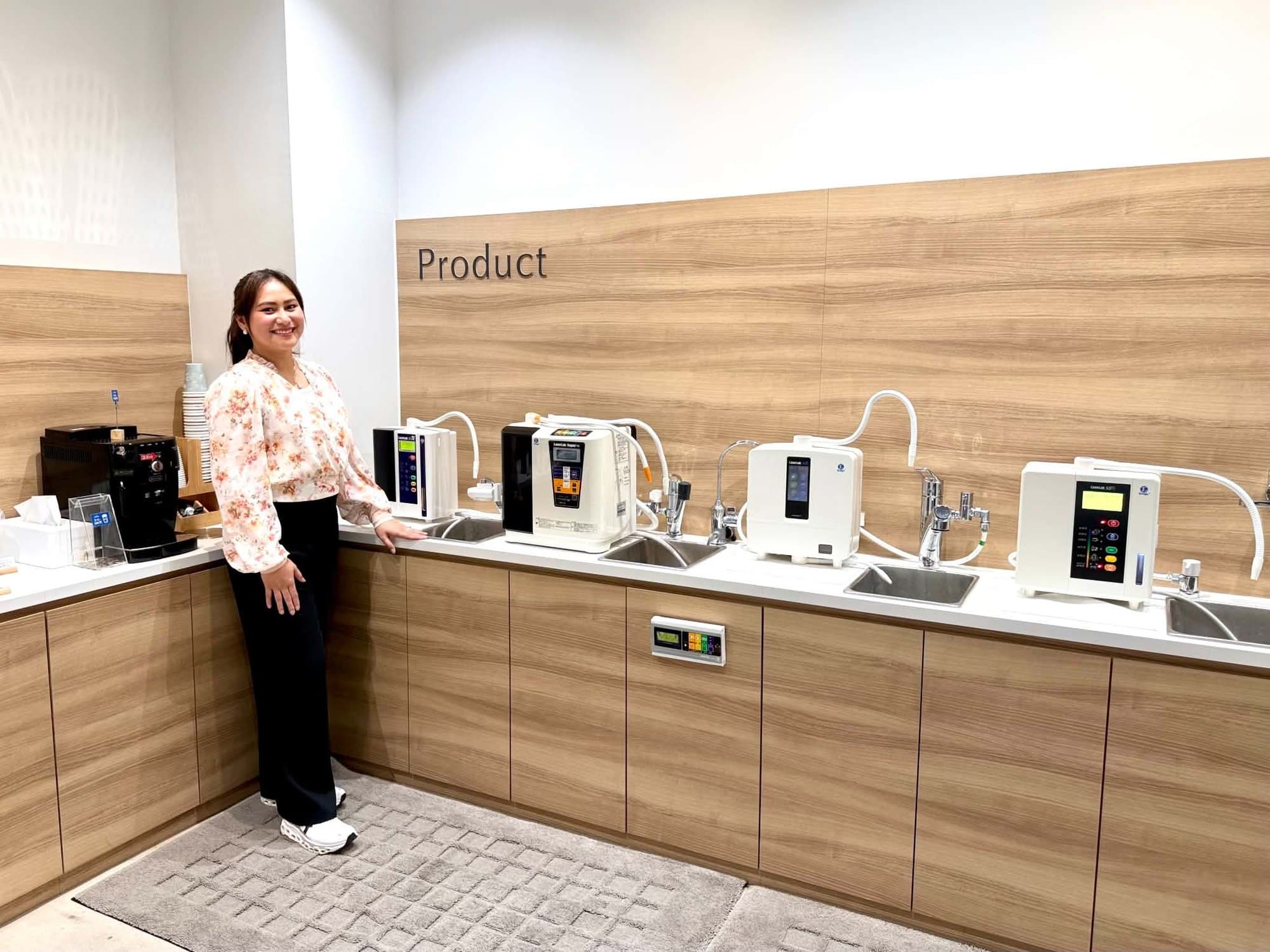
Every unit in the showroom is connected to a working tap, which is the only way to see how a machine actually behaves.
The process
Connect, filter, electrolyze, select, use.
A Leveluk does the same five things every time you open the faucet. The machine sits between your tap and your glass, and each stage below is a part of the unit doing one job.
Connect at the tap
The machine stands on the counter and connects to your kitchen faucet through a diverter. Move the diverter lever to the processed-water position and your tap water is directed into the Leveluk instead of straight down the sink.
Filter inside the machine
The first thing the water meets is the machine's internal filtration, which helps reduce impurities from your tap supply before any current is applied. The electronics track how much water has passed through the cartridge and tell you when a new one is due.
Electrolyze in the chamber
Filtered water passes into the electrolysis chamber, which holds the electrode plates — platinum-coated titanium, sitting either side of a membrane. A controlled current separates the water: an alkaline stream is drawn from the cathode side, an acidic stream from the anode side.
Select at the panel
The panel is where you tell the machine what to make. On the Leveluk K8 the home screen carries pH 8.5, 9.0 and 9.5 for Kangen Water, pH 7.0 for Clean Water, pH 6.0 for Beauty Water and pH 2.5 for Strong Acidic Water. Beauty Water and Strong Acidic Water are not for drinking. Other models have their own panels and their own labels.
Use the water it delivers
Open the faucet and the water you chose leaves through the corresponding outlet — on the K8, processed water is discharged from the flexible pipe. On the pH 2.5 setting both pipes run at once: Strong Kangen Water from the flexible pipe and Strong Acidic Water from the secondary pipe, and neither of those is for drinking. Production is continuous, so the machine makes water as it runs rather than batching it in advance.
Inside the machine
Four parts, four jobs.
Filtration, electrolysis, the electrode plates and the two measurements a specification sheet quotes. Everything a Leveluk does comes out of these.
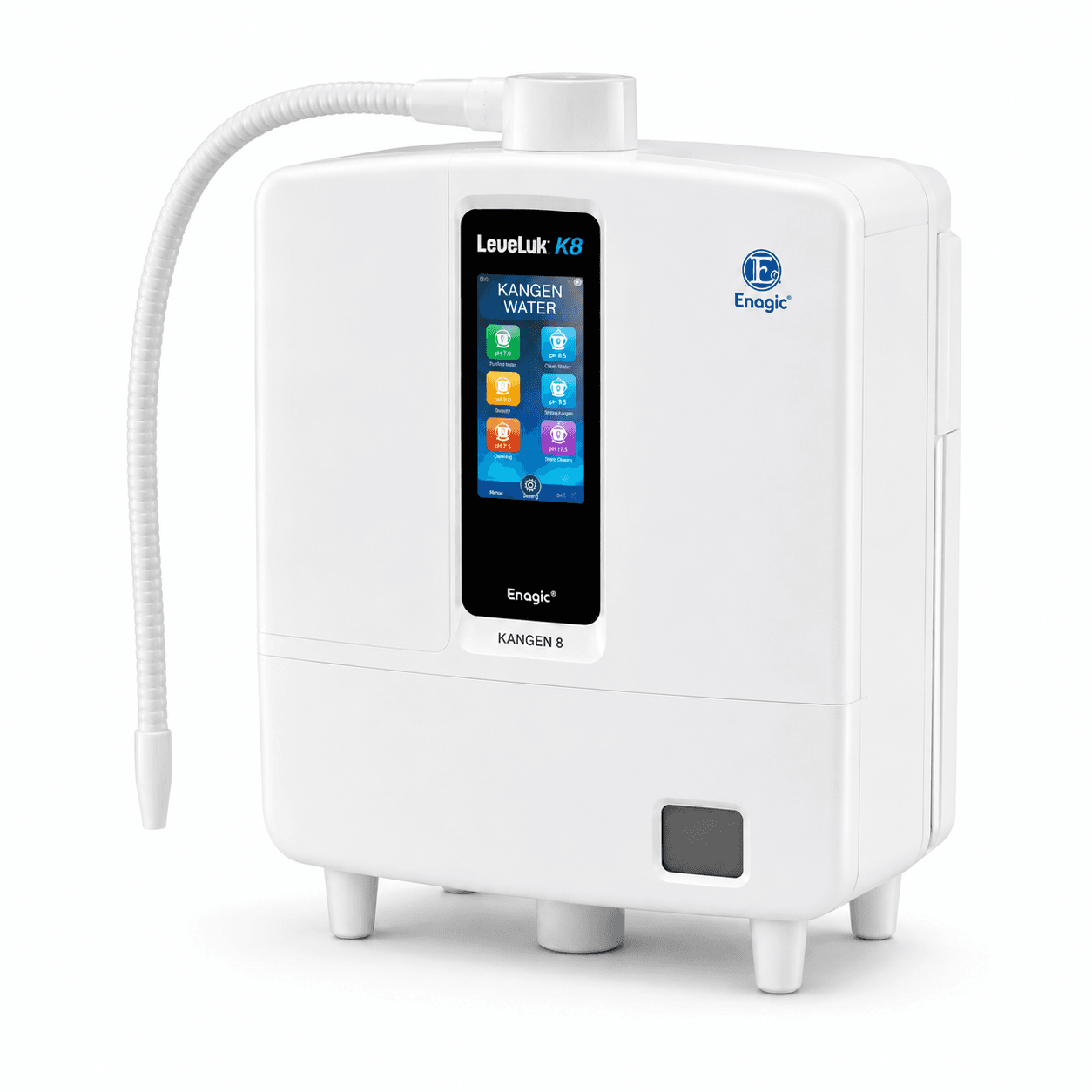
The Leveluk K8. Filter, plates and panel are all behind this one casing — nothing sits under the sink.
Filtration
The first thing water meets inside the machine is a filter cartridge, and it does its work before any current is applied. It helps reduce impurities from your tap supply rather than stripping the water down — the minerals already in it are kept. Every Leveluk ionizer carries smart filter electronics that count the water through the cartridge and tell you when it is due; the K8's F8 filter is rated at roughly 6,000 litres or one year, whichever comes first.
Filters and replacementElectrolysis
Filtered water then enters the electrolysis chamber. A controlled current is applied across the plates and a membrane holds the two results apart: an alkaline stream is drawn from the cathode side, an acidic stream from the anode side. Nothing is dosed into the water — no powders, no drops, no mineral cartridge. The alkalinity comes from the current acting on what your tap already supplied.
Electrolysis, explainedElectrode plates
The plates are titanium, dipped in platinum, and they sit either side of the membrane. Plate count is one factor in a machine's capacity, alongside plate size, surface area and power: the Leveluk Jr. IV has 4, the K8 has 8 at 135 × 75 mm, and the Super 501 runs a dual system of 7 and 5. All three produce the same five water types — what changes is throughput, and how well a machine holds its output at volume.
Compare the ionizerspH and ORP
Two different measurements, usually quoted together. pH says how acidic or alkaline the water is; the K8's published range is pH 2.5 to 11.0. ORP — oxidation-reduction potential — is a millivolt figure describing the water's electrochemical character, and ionized water carries a negative one. The published values differ by model: −450 mV for the Jr. IV, −722 mV for the K8, −800 mV for the Super 501.
ORP and pH, explained
The vocabulary
The words on a spec sheet.
Every term a Leveluk's documentation and a demonstration will use, defined once, in plain language.
- Water Ionization
- Source water is separated into alkaline and acidic streams, giving you a range of water types from a single tap.
- Electrolysis
- A controlled electric current drives the separation process — the core of how each water type is produced.
- Electrolysis Chamber & Membrane
- Inside the chamber a membrane keeps the streams apart — alkaline water is drawn from the cathode side and acidic water from the anode side.
- Platinum-Coated Titanium Plates
- Durable electrode plates dipped in platinum sit at the heart of every Leveluk system. More plates, more capacity.
- Filtration
- A built-in filter helps reduce impurities from your tap water before ionization begins.
- pH Range
- From a strongly acidic pH 2.7 to a strong alkaline pH 11.0 — selectable at the panel for the task at hand.
- ORP Concept
- Oxidation-reduction potential describes water's electrochemical character — a property often discussed alongside ionized water.
- Built-in Cleaning
- Automatic cleaning cycles help keep the internal electrode chamber maintained over years of use.
- Smart Filter Reminders
- Onboard electronics track usage and prompt you when it's time to refresh your filter.
- Adjustable Water Settings
- Select between the water types at the panel to match the task — drinking and cooking through to beauty and cleaning.
- Full-Colour Control Panel
- A full-colour LCD with multi-language voice guidance walks you through everyday operation.
- Continuous-Flow Design
- A continuous-flow ionizer produces water on demand, straight from your tap — no waiting or batching.
- Energy-Saving Operation
- Auto on/off, plug-and-play setup and a multi-voltage power supply keep everyday use simple and efficient.
Molecular hydrogen
H2 and H2O are not the same thing.
Hydrogen-rich water is one of the reasons people find this technology interesting, and one of the things most often described loosely. Here is what the term means, where a Leveluk produces it, and what the published research has and has not settled.
A dissolved gas, not the water itself.
In a Leveluk the gas is produced at the cathode side of the membrane — the same side the drinking water is drawn from. That is why the alkaline settings are the ones described as hydrogen-rich, and the acidic settings are not.
It is also why these machines run continuously from the tap instead of filling a tank: dissolved hydrogen is a gas on its way out from the moment the water is poured.
Where this happens in the machine- H₂ is not H₂O
- Water is one oxygen atom bonded to two hydrogen atoms: H₂O. Molecular hydrogen is two hydrogen atoms bonded to each other and nothing else: H₂, which is a gas. In a glass of hydrogen-rich water that gas is dissolved in the water, the way carbon dioxide is dissolved in a sparkling drink — the water is not made of it, and the H₂O in the glass is not where it comes from. This is the distinction marketing blurs most often, and everything else here depends on it.
- Where it comes from
- Electrolysis splits some of the water at the electrodes. Hydrogen gas can be produced in the drinking-water stream at the cathode side of the membrane — the same side the alkaline water is drawn from. Nothing is dosed into the water to put it there; it is a product of the current running across the plates, which is why an ionizer produces it and a filter jug does not.
- Hydrogen-rich and alkaline are two different properties
- They travel together in an ionizer only because one process happens to produce both. pH describes how acidic or alkaline water is. Dissolved hydrogen is how much H₂ gas the water is carrying — a separate property, measured separately, in different units. Water can be alkaline and carry no dissolved hydrogen at all: an alkaline mineral filter raises pH without electrolysis and without producing any gas. A claim about pH and a claim about hydrogen are two claims, and each one has to stand on its own.
- It does not last
- Dissolved gas leaves. H₂ begins escaping the moment the water meets air, so a figure measured at the outlet is not the figure an hour later in an open glass on the counter. That is the practical reason a continuous-flow ionizer is built to make water on demand at the tap, as you draw it, rather than to store it — and the reason water that has been bottled, shipped and stood on a shelf is a different proposition.
- What the research does and does not establish
- Molecular hydrogen is an active research field with two decades of published work behind it, and it is still developing. Much of that literature is early-stage: laboratory work, animal models, and human studies that are small and short. It is a field in progress rather than a settled question, and reading the papers is a different exercise from reading the headlines written about them.
No health claims are made here
Everything above is chemistry and process, plus a description of what researchers have looked at. None of it says what any water will do for any person. Kangen Water is not a medication and is not a cure for any health condition, nothing on this page is medical advice, and individual experience varies. If you have a health question, speak to a healthcare professional, and verify product details with official Enagic materials and authorized Enagic representatives.
The five water types
One machine, five settings.
Every Leveluk ionizer produces the same five water types, from strongly acidic to strong alkaline. Two of them are intended for drinking. The other three are for household and external use, and are labelled that way everywhere they appear.
For drinking
Two of the five settings
pH8.5 – 9.5
For drinking
Kangen Water
Mildly alkaline water for everyday drinking and cooking — the heart of the Enagic hydration routine.
- Everyday drinking
- Cooking rice & soups
- Coffee & tea
Your daily glass, your morning coffee, your family's cooking.
pH7.0
For drinking
Clean Water
Filtered, pH-neutral water for moments when you want a clean, neutral glass.
- Neutral drinking water
- Preparing baby food
- Taking with medication
A clean, neutral glass for the whole family.
Not for drinking
Three of the five settings — household and external use only
pH11.0
Not for drinking
Strong Kangen Water
A strong alkaline water for cleaning and food-preparation tasks around the home — not intended for drinking.
Typical uses
- Food preparation
- Soaking & cleaning produce
- Tough cleaning tasks
Prepping vegetables and cleaning around the kitchen.
pH4.0 – 6.0
Not for drinking
Beauty Water
A mildly acidic water often used as a toner in beauty routines — for external use, not for drinking.
Typical uses
- Skin toning
- Beauty & grooming routine
- Gentle surface cleaning
A refreshing part of your morning and evening beauty routine.
pH2.7
Not for drinking
Strong Acidic Water
A strongly acidic water for cleaning and household hygiene tasks — not intended for drinking.
Typical uses
- Cleaning surfaces & utensils
- Wiping down kitchen areas
- General household hygiene
Keeping kitchen surfaces and utensils fresh and clean.
What the panel actually says
Panel labels vary by model, and they are not the water-type names. A setting named for a pH value produces one of the five water types, and the mapping is printed on the machine’s own panel and in its manual. One behaviour is shared across the ionizers: on the strongest acidic setting both outlets run at once, and neither of those two streams is for drinking.
The figures listed above belong to the water types themselves; the figures on a panel are the settings that produce them, and the two are quoted differently — Strong Acidic Water is listed here at pH 2.7, while the tile that produces it is labelled pH 2.5. Read the settings off your own unit rather than another model’s documentation.
Using your system, setting by settingWater-type uses are general product education. Official Enagic guidance governs drinking and non-drinking use.
Everyday use
Choosing a setting, and what the machine does after.
Two short routines cover almost all of ownership: the sequence at the tap, and letting the automatic cleaning cycle finish.
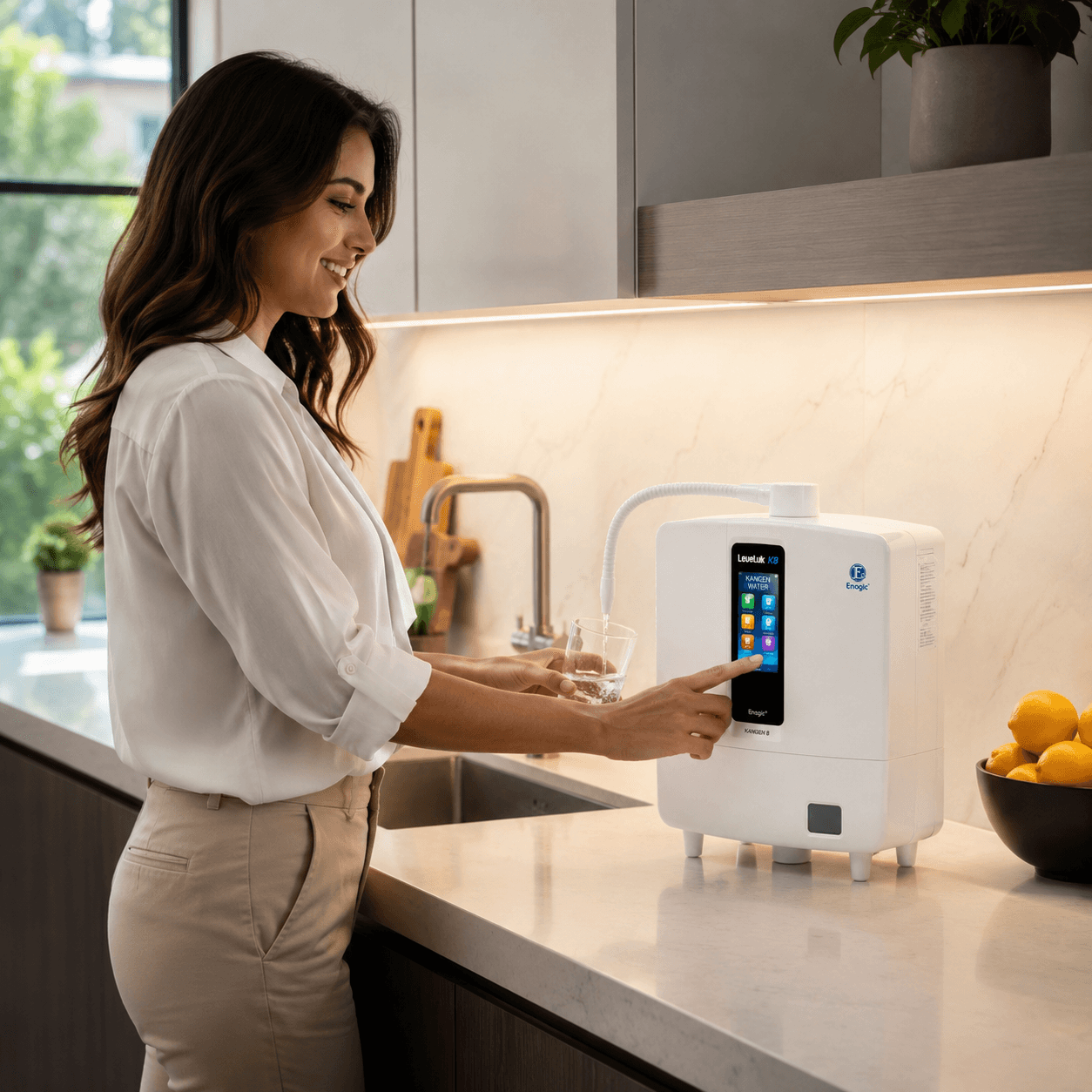
Selecting a setting
Operation is short and the same every time. The sequence below is the K8’s, taken from its operation manual; other models follow the same shape with their own panel.
- Move the diverter lever on the tap to the processed-water position.
- Touch the water you want on the home screen.
- Open the faucet — processed water is discharged from the flexible pipe.
- Close the faucet to stop.
- Let the automatic cleaning cycle finish, and do not use the water it discharges.
Strong Acidic Water is the exception: on the K8 the electrolysis enhancer tank has to be installed before the pH 2.5 setting can do its work, and the Super 501 carries an enhancer tank built into the unit. Neither Strong Acidic Water nor the Strong Kangen Water produced alongside it is for drinking.
Using your systemCleaning
Every Leveluk ionizer in this catalogue cleans its own electrode chamber automatically, and on the Super 501 the cycle is microcomputer controlled. On the K8 it runs after use and discharges water while it works — that water is not to be used, for drinking or for anything else, and the machine should be left to finish before it is used again. A unit that starts discharging water on its own is, far more often than not, doing exactly this rather than failing.
Outside that cycle, care is ordinary: a soft dry cloth on the housing, the flexible pipe kept clear of the basin, the surface underneath kept dry. Anything with an interval attached is specified per model in that unit’s own manual and shifts with how hard your tap water is, so take it from there rather than from here.
Cleaning & maintenanceQuestions
The questions this page raises.
Kangen Water is not a medication and is not a cure for any health condition. The wellness answers below describe what Enagic publishes and what published research on molecular hydrogen reports — they are product education, not medical advice, and individual experience varies. Always consult a healthcare professional about your own health, and verify product details with official Enagic materials and authorized Enagic representatives.
See it running
What a demonstration shows.
Reading about the chamber is one thing. Watching a machine run through its settings at a real tap is another.
The panel, setting by setting
Which settings the machine offers, what each one is for, and which of them are not for drinking.
The machine at a real tap
How the unit connects through the diverter, how the flow behaves, and what the everyday routine looks like.
The models beside each other
The Jr. IV, the K8 and the Super 501 differ in electrode plates and capacity. Seeing them together makes that difference concrete.