Stand in front of a water ionizer and two numbers do most of the persuading: a pH figure and an ORP figure in millivolts. Both are real measurements of real properties. Both are also routinely asked to mean more than they do.
Understanding them takes a few minutes and makes the rest of the category much easier to navigate.
pH: how acidic or alkaline
The pH scale runs from 0 to 14, with 7 as neutral. Below 7 is acidic, above is alkaline. It is logarithmic, which is the part most explanations skip: each whole step is a tenfold change, so pH 9 is ten times less acidic than pH 8, not slightly.
Ionizers quote a range — commonly 2.5 to 11.5 across the current lineup — describing the span the machine can produce across all its settings. That is not what comes out of the drinking tap. The drinking settings sit in a much narrower band, and the extremes belong to the cleaning and rinsing streams that leave by the second outlet.
ORP: which direction the water tends
Oxidation-reduction potential, measured in millivolts, describes whether a solution tends to give up electrons or take them. A positive figure indicates an oxidising tendency; a negative one indicates a reducing tendency.
In this category ORP is quoted as a strongly negative number — figures across the current lineup run from about −450 mV to −800 mV — and it is treated as the headline measurement. Here is the honest description of what it is doing: ORP is an indirect indicator. A strongly negative reading is consistent with dissolved hydrogen being present, which is why it tracks with what the machine is doing, but ORP is not a hydrogen measurement.
The direct measurement is dissolved H₂ in ppm or mg/L, which is bounded by the roughly 1.6 mg/L ceiling described in what molecular hydrogen is. ORP gets quoted more often partly because it produces a more dramatic-looking number.
Why readings move
What neither number tells you
Neither pH nor ORP says anything about what water does inside a person. They are properties of a liquid, measurable on a bench, and that is the full extent of what they establish.
When a demonstration moves quickly from a millivolt reading to a claim about health, a step has been skipped — and it is the step that would require clinical evidence rather than a probe. Where that evidence actually stands is set out in what the research has and has not shown.
This article describes measurements of water. It makes no health claim, and no product mentioned treats or prevents any condition.
The demonstration you will probably be shown
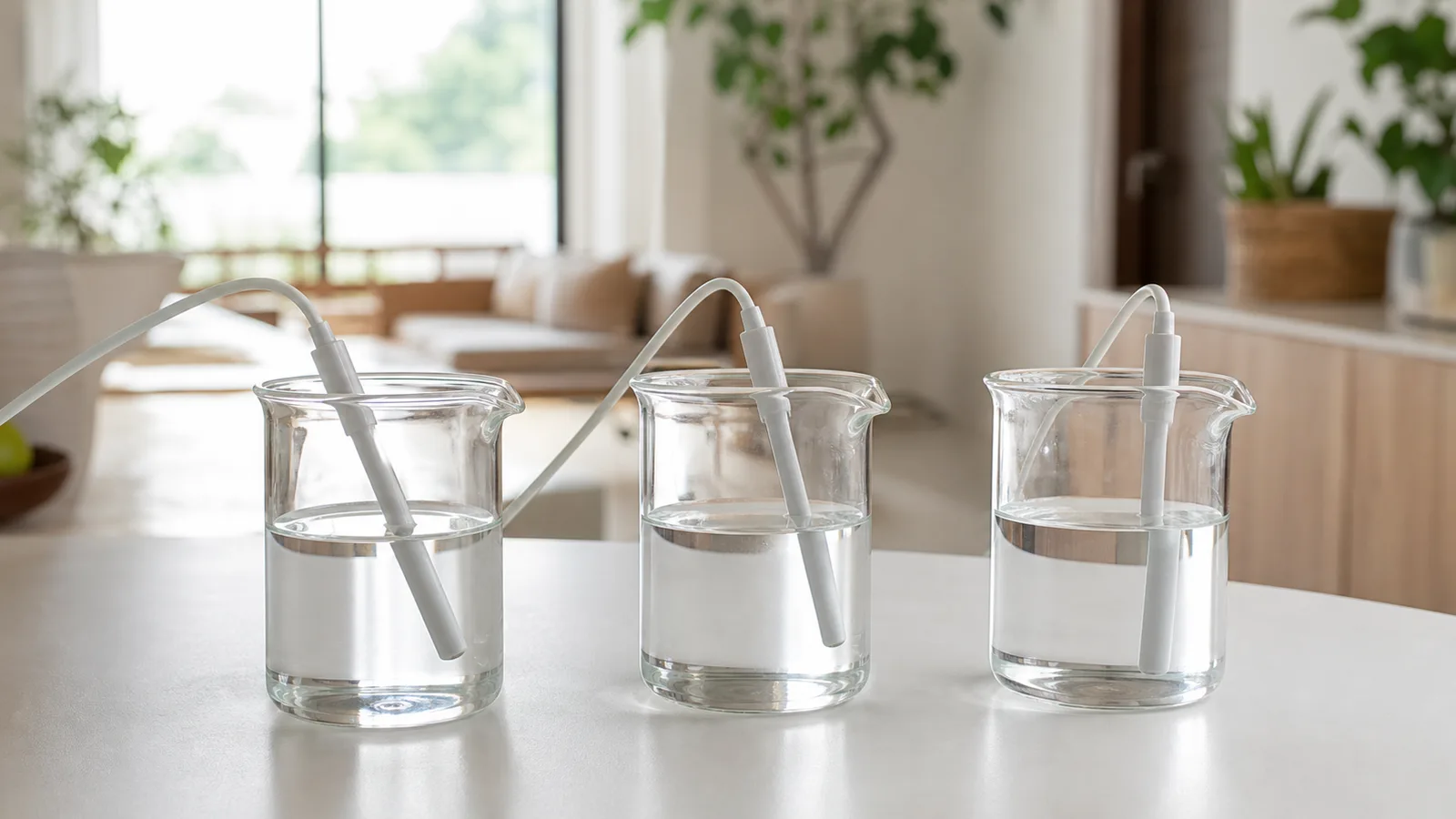
A common sales demonstration uses a reagent — often a pH indicator — to turn glasses of water different colours, or a small meter to show a negative ORP against a positive one from tap water.
Neither is dishonest in itself. Both show a real difference. The thing to watch is what is claimed from the demonstration: that the water is measurably different is supported; that the difference does something in a body is a different claim needing different evidence.
Reasonable questions during any demonstration: what is this meter, when was it calibrated, what is the reading on my own tap water, and what is the dissolved hydrogen figure in ppm rather than the ORP.
The summary
pH is a logarithmic scale of acidity and the quoted range covers all settings rather than the one you drink. ORP is an indirect indicator that tracks dissolved hydrogen without measuring it. Both drift with time, temperature and your own supply. Neither says anything about health.
That is the whole of it, and it is enough to read any panel in this category without being led anywhere by it.
Sources
Filed under
- Hydrogen Water
- ORP
- pH
- measurement
- water chemistry
- ionizer