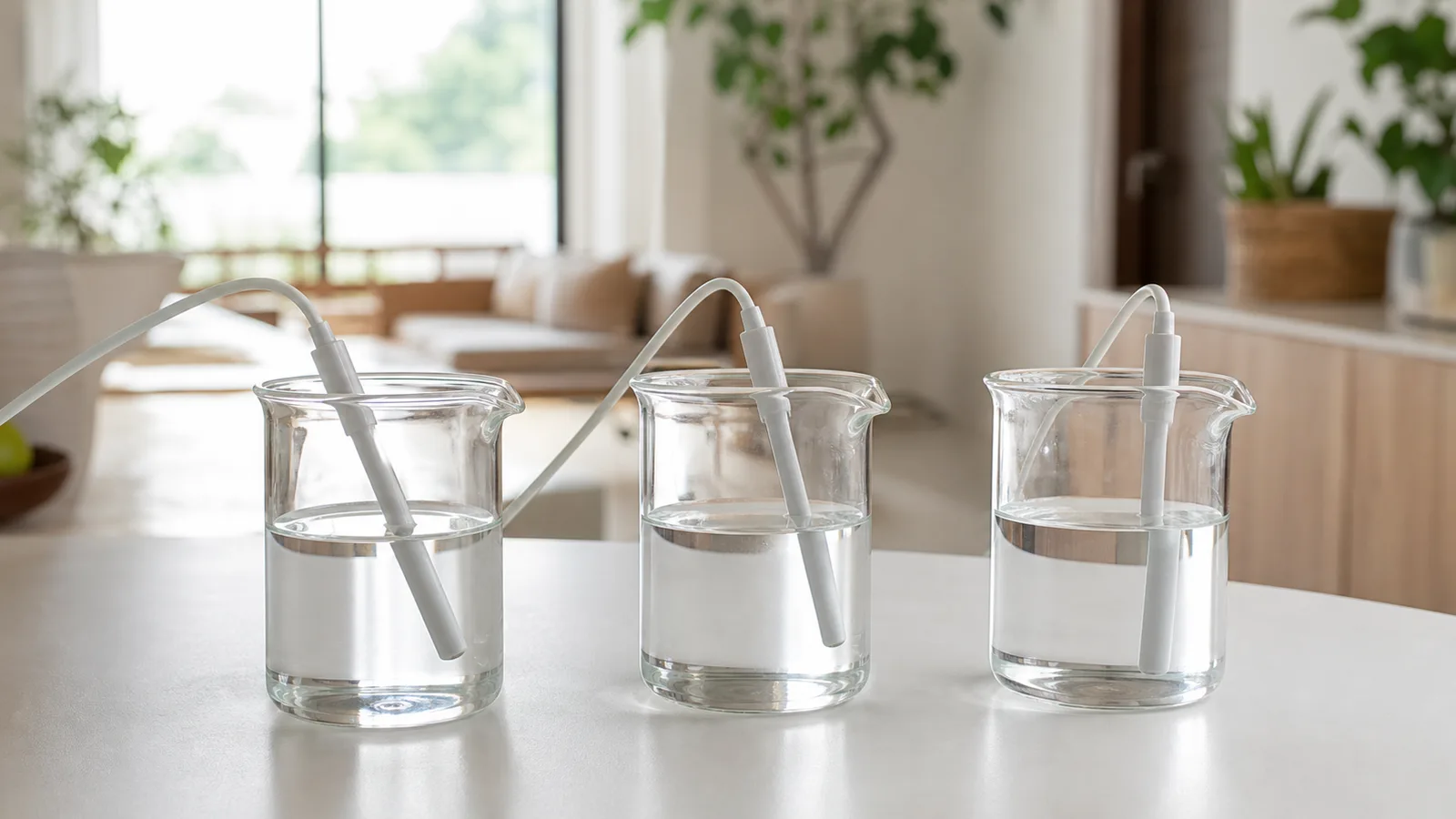
A water ionizer raises the pH of one stream and dissolves hydrogen gas into it at the same time. Because both happen in the same glass, the two get talked about interchangeably — and they should not be, because they are separate assertions resting on separate evidence.
Keeping them apart is the single most clarifying thing you can do in this subject.
This article summarises published research for general education. It is not medical advice, and nothing sold on this site treats, prevents or cures any condition.
The two claims, stated separately
The alkaline claim, and why it fails
Blood pH is held within a narrow range by the lungs and the kidneys. It is one of the most tightly regulated variables in the body, and it is not adjustable by diet or drink — if it were, that would be a medical emergency rather than a wellness feature.
Stomach acid is also considerably stronger than any alkaline drinking water, so water arriving in the stomach is neutralised well before absorption. This is not a controversial point; it is basic physiology.
There is a narrow exception worth naming for completeness: alkaline water has been studied in the specific context of reflux symptoms, with limited and contested results. That is a specific clinical question, not a general health claim, and it is not a reason to buy anything.
The hydrogen claim, and what it actually has
This one has a real literature. Molecular hydrogen has been studied in cells, animals and — increasingly — in small human trials, and the mechanistic proposals are chemically coherent rather than nonsense.
What it does not have is settled evidence of a health effect in ordinary people drinking a glass of water. The human trials are typically small, short and heterogeneous in design, and reviewers say so explicitly — what hydrogen water research has and has not shown and, for the best-studied area, hydrogen water and exercise recovery.
"Preliminary and unsettled" is a genuinely different position from "contradicted by physiology". Both deserve scepticism; they do not deserve the same scepticism.
Why the distinction matters when you are buying
Because a seller who merges them is either confused or relying on you to be. The alkaline claim is the easier one to make dramatic — it comes with a number on a display and a colour-changing reagent — and it is the one with no support.
So when a pitch moves from "the pH is 9.5" to a statement about your body, that is the alkaline claim being made, and it should be treated as such. The full sorting of what gets said at demonstrations is in common claims about hydrogen water, checked.
The practical answer
Buy a machine like this for reasons that hold regardless of how the hydrogen research eventually settles: filtered water available at the tap, no delivery logistics, a household that drinks more water, and a cost comparison that works over years — what it costs to run a hydrogen water system.
Do not buy it for the alkaline claim, because that claim is not supported. And treat the hydrogen claim as what it is — an open question that may or may not resolve in the product's favour, and one nobody should be charging a premium for today.
Sources
- Molecular Hydrogen Therapy — A Review on Clinical Studies and Outcomes (2023). Molecules.
- Can molecular hydrogen supplementation enhance physical performance in healthy adults? A systematic review and meta-analysis (2024).
- US National Library of Medicine, MedlinePlus — Blood gases and acid-base balance.
Filed under
- Hydrogen Water
- alkaline water
- pH
- claims
- evidence
- comparison