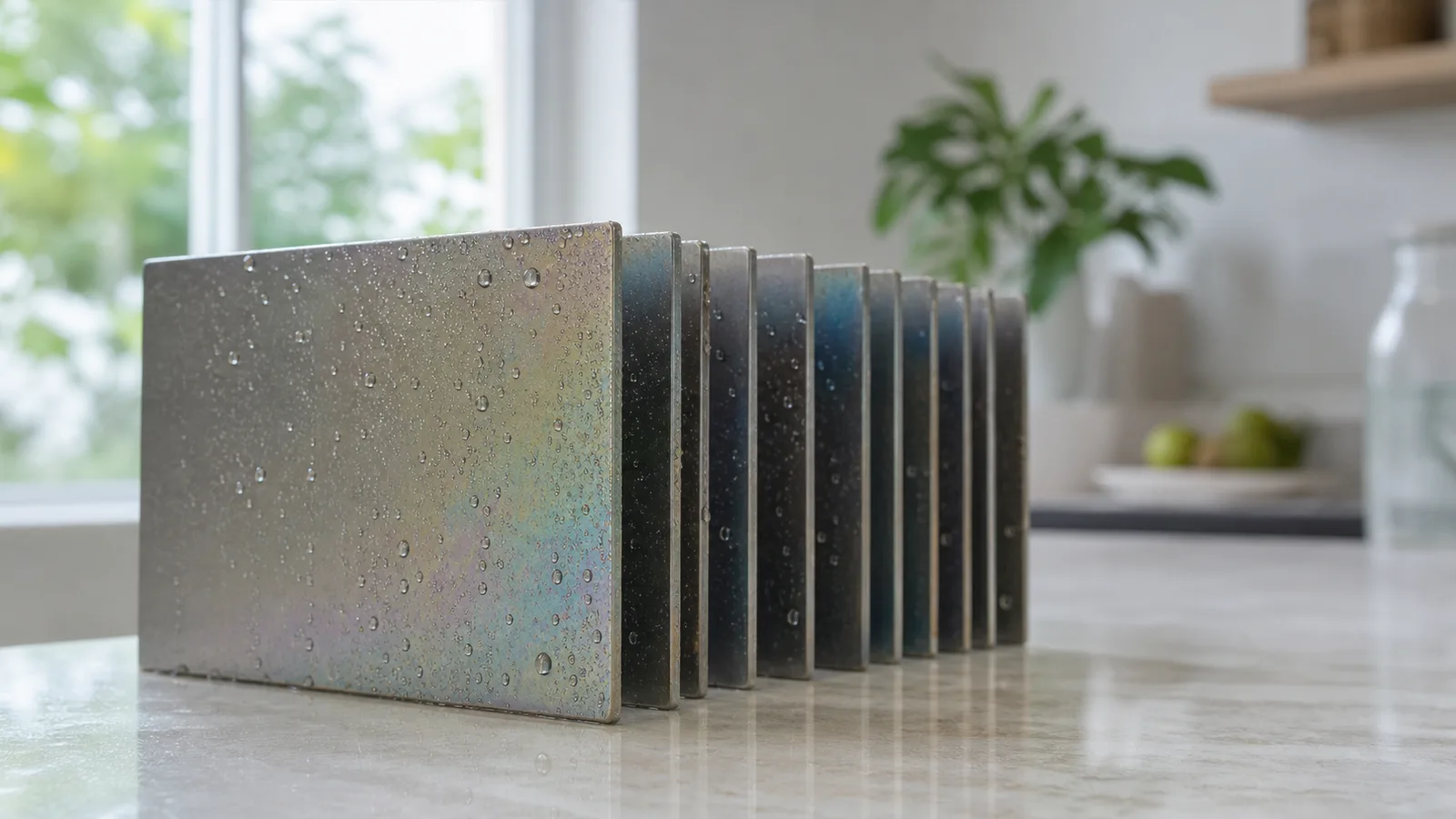
All three machines run the same process on the same 135 × 75 mm plates and produce the same five water types across a similar pH range. What separates them is capacity, footprint, power and warranty — which is to say, which household they suit rather than which is better.
Figures below come from this showroom's catalogue and can change. Confirm current specifications, warranty terms and pricing with official Enagic materials and an authorized representative before buying. This is appliance information, not medical advice.
Where they actually differ
Power draw also differs — 120 W for the Jr. IV, 200 W for the Super 501, 230 W for the K8 — but since these run in bursts rather than continuously, it is a minor line in a household bill rather than a deciding factor. The arithmetic is in the energy your appliances actually use.
The question that should decide it
Not plate count. How much water your household draws at once, and how much counter you have.
A household filling two or three bottles a day is served by any of the three. A household filling a large container for cooking, filling bottles for four people before school, and doing it in the same fifteen minutes every morning is a different case — that is where flow rate stops being a number and starts being how long you stand at the sink.
Who each one is for
- Jr. IV — individuals and smaller homes. The compact starter: smallest footprint, lowest power draw, same five water types.
- K8 — the flagship, and the one whose extras are interface rather than water: full-colour panel, voice guidance, eight-language display, and the longest warranty of the three.
- Super 501 — large households and shared spaces, where sustained output is the point. It is also the biggest and heaviest, which a small kitchen will notice.
The K8's display features are real and mostly matter in year one; which parts of a panel still earn their place afterwards is argued in panels, presets and voice guidance.
What not to decide on
ORP figures are quoted for all three and differ between them. They are measured under manufacturer conditions and are not a household experience — what the number describes, and what it does not, is set out in ORP and pH: what the numbers on the panel mean.
And none of the three should be compared on health grounds, because that is not a comparison anyone can make honestly. What the research supports is the same for all of them, and it is covered in what hydrogen water research has and has not shown.
Before any of it
Settle the boring things first: where it will sit, what the plumbing under that sink looks like, what the filter costs per year, and who services it locally. Those decide satisfaction more reliably than the model does — how to read a water system spec sheet and designing a kitchen around a water system.
Sources
Filed under
- Water Technology
- comparison
- buying guide
- leveluk
- specifications
- household