Ask what separates one water ionizer from another and the first answer is almost always the plate count. Four plates, eight plates, twelve. It is printed on the box, it scales with the price, and it is the easiest number in the category to turn into a ranking.
It is a real specification and it does real work. It is also not a score — and the clearest demonstration of that is the published figures for the machines themselves.
What the plates are actually doing
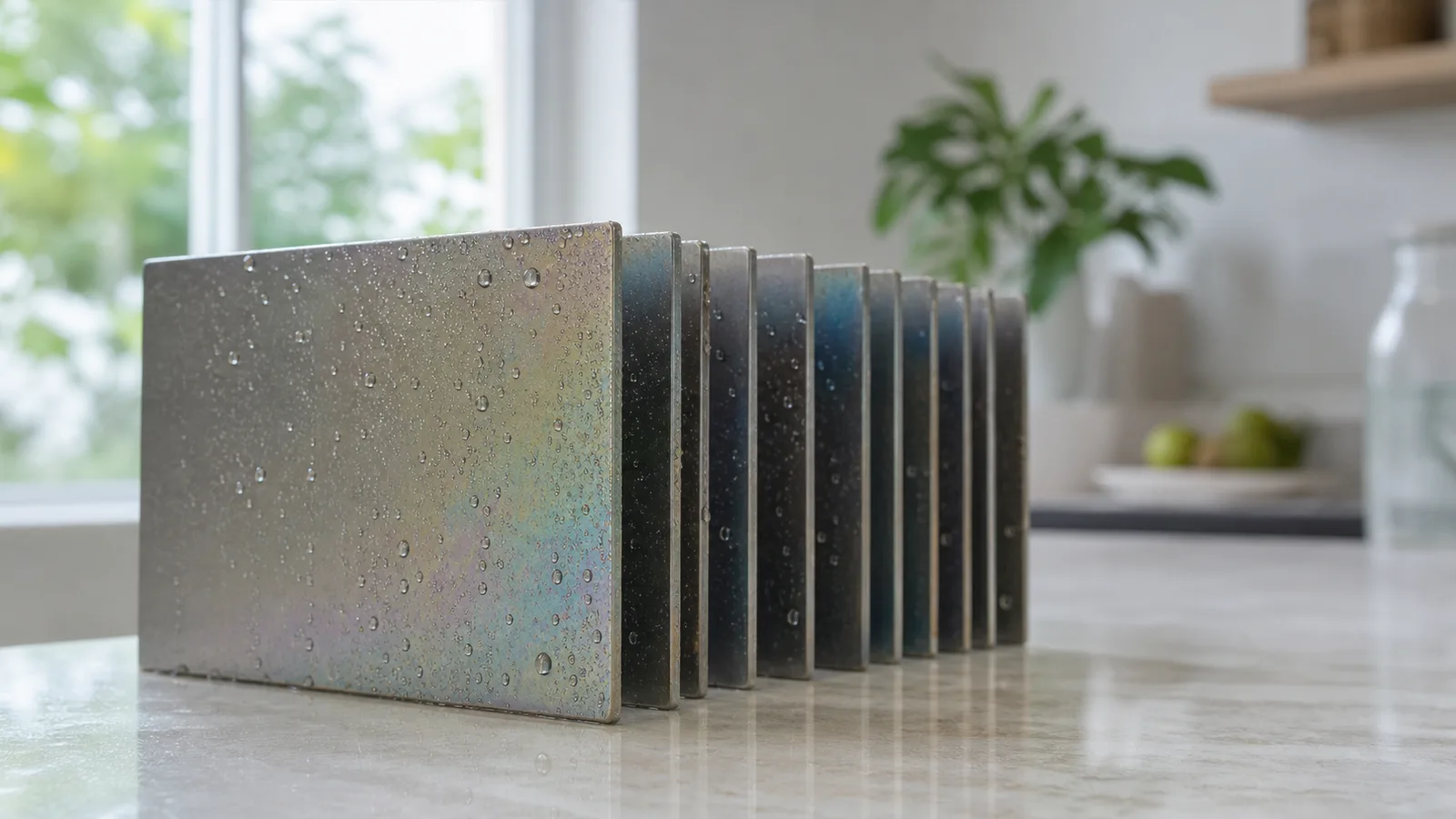
The plates are the electrodes. Water passes between them, current is applied, and the reaction described in electrolysis, explained without the jargon happens at their surfaces: hydrogen on one side, oxygen on the other, and the two streams that leave the machine separately.
Because the reaction happens at the surface, the amount of surface available is one of the factors that decides how far the reaction goes in the time the water is inside. More plates means more surface area, which means more of the water in contact with an electrode at any moment.
What the published figures actually show
Set the three current models side by side using their own published specifications and the picture is more interesting than a ladder.
| Model | Plates | Negative ORP | Production rate | Power |
|---|---|---|---|---|
| Leveluk Jr. IV | 4 | −450 mV | 3.0 – 4.9 L/min | 120 W |
| Leveluk K8 | 8 | −722 mV | 3.5 L/min (Kangen) | 230 W |
| Leveluk Super 501 | 7 & 5 (dual) | −800 mV | 4.9 – 7.9 L/min | 200 W |
Two things fall out of that table immediately. The first is that plate count does track with the strength of the reaction: the negative ORP figure climbs from −450 mV on the four-plate unit to −722 mV on the eight-plate one and −800 mV on the dual-plate system. That is the effect you would expect from more electrode surface.
The second is that plate count does not track with throughput. The four-plate Jr. IV is rated up to 4.9 L/min; the eight-plate K8 is rated at 3.5 L/min for Kangen water. On the number a large household actually feels — how fast the jug fills — the smaller machine is not behind at all.
Why a bigger machine can be slower
It is the same trade-off, seen from the other end. Water that moves quickly across the plates spends less time in the reaction; water that lingers shifts further. A machine designed to reach a stronger ORP may deliberately hold the water longer, and that shows up on the spec sheet as a lower flow rate.
The Super 501 sidesteps the trade by using two plate groups — a dual system rather than a single stack — which is how it reaches both the highest ORP figure and the highest flow in the lineup. It is also the largest and heaviest unit, which is its own kind of cost on a counter.
None of that makes any of the three the right answer. It makes them different answers to different household questions, which is the point.
How to actually use the number
The honest ordering question for most households is not "how many plates" but "how much water, how fast, in what space, at what running cost". Plate count is one input to that. The comparison puts all of the inputs on one row.
Figures quoted here come from the showroom's own catalogue and can change. This article describes an appliance specification; it is not medical advice, and no machine described treats or prevents any condition.
What comes next
Flow rate is the number that deserves more attention than it gets in this category, particularly for larger households — it is worked through in flow rate and why it matters. If plate count is being quoted at you as the reason for a price difference, how to read a water system spec sheet sets out what else should be on the page.
Sources
Filed under
- Water Technology
- electrode plates
- water ionizer
- specifications
- buying guide
- ORP