Every machine in this category is sold partly on its interface: a colour display, a number of presets, voice prompts, a count of supported languages. It is the part of the specification that demonstrates best in a showroom and matters least in year two.
Which is not to say it is irrelevant. It is to say the useful question is which of it you will still be using after the novelty passes.
What the presets actually are
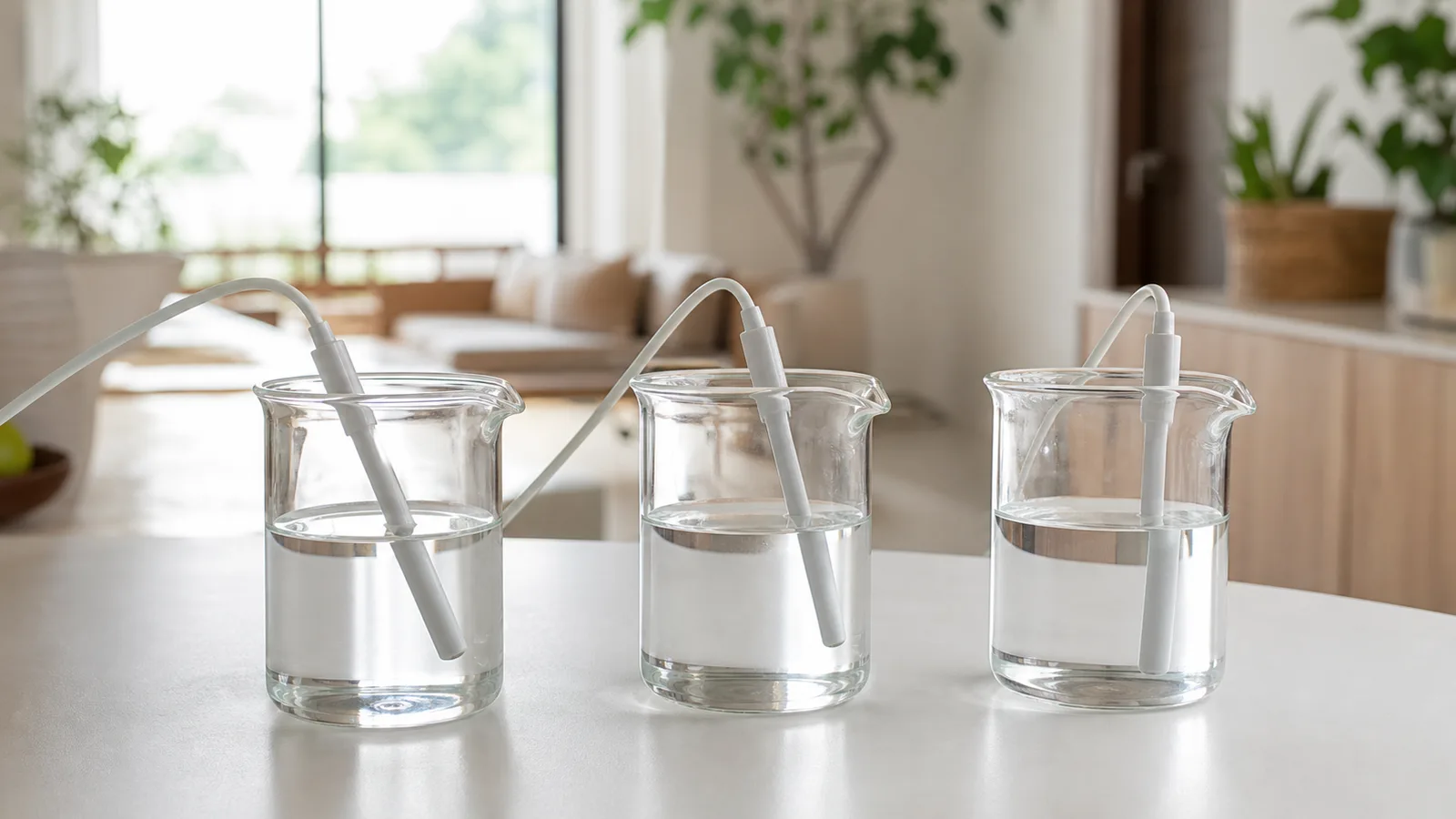
The current lineup produces five water types, which is the figure quoted on every spec sheet. Broadly they fall into three groups: settings intended for drinking, a neutral setting, and settings at the ends of the range intended for cleaning and rinsing rather than consumption.
The pH range quoted for a machine — commonly 2.5 to 11.5 — describes the span across all of those, not what comes out when you fill a glass. That distinction is where most confusion about these numbers starts, and it is unpicked in ORP and pH: what the numbers on the panel mean.
The display, and what it is genuinely for
A screen is worth having for reasons that have nothing to do with how it looks in a demonstration.
Everything beyond those is presentation. A full-colour panel is pleasant; it does not treat water any differently from a simpler one.
Voice guidance and language counts
The K8 lists voice prompts and an eight-language display. Both are real features and both are usually discussed for the wrong reason.
Voice guidance is genuinely useful in two situations: a household member who cannot easily read a small screen, and a machine positioned where the panel is not at eye level. Outside those, most households turn it off within a month.
Language count is an export feature. It exists so the same unit can ship to many markets — the same logic as the multi-voltage supply described in multi-voltage and power in Philippine homes. It is a manufacturing fact rather than a benefit to you, unless a member of your household actually needs one of those languages.
How to weigh the interface when comparing
- Does it count filter litres and show them clearly? Yes is worth real money. No means you are keeping that schedule yourself.
- Can you tell at a glance which setting is running?
- Is the panel readable in your kitchen's light, at the height it will sit?
- Do the settings you will actually use take one press, or are they buried?
- Ignore the preset count past the ones you have identified you need.
Those five questions place the interface where it belongs in a purchase decision — behind flow rate, filter cost, footprint and service, all of which are covered in how to read a water system spec sheet.
Features quoted come from the showroom's catalogue and can change; confirm against official Enagic materials. Follow the machine's manual on which settings are intended for drinking. This is appliance information, not medical advice.
Sources
Filed under
- Water Technology
- presets
- interface
- water types
- daily use
- buying guide