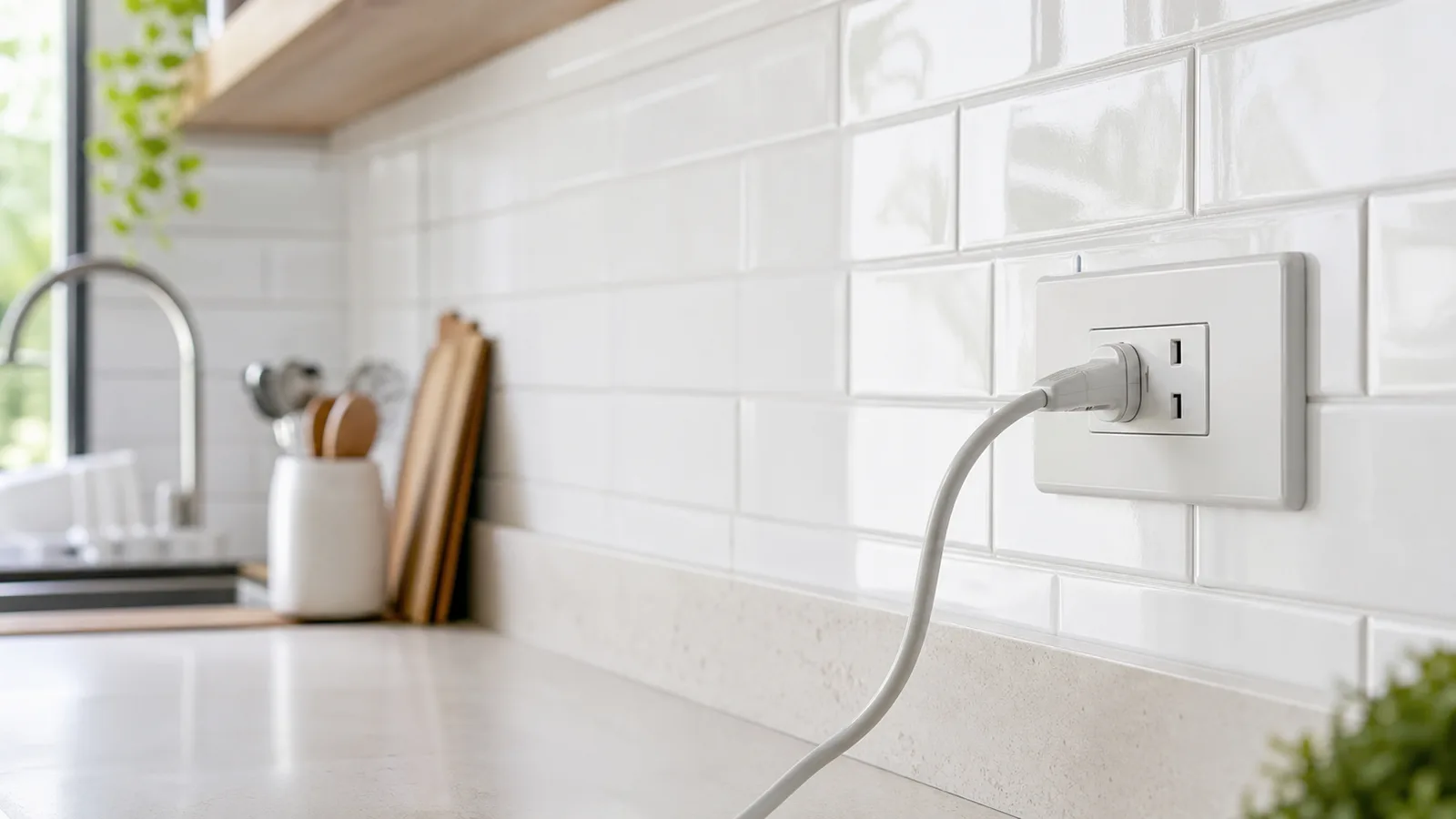
The Philippines has an unusual electrical arrangement: mains at 220 volts, and sockets that accept the flat two-pin plugs used in 110-volt countries. The plug fits. The voltage does not. That combination has destroyed a great many imported appliances, and it is the first thing to check before plugging in anything bought abroad or shipped in.
For a water system — which sits in a kitchen, near water, and is expected to last a decade — it is worth understanding rather than assuming.
General information. Electrical installation should be done by a qualified electrician following the Philippine Electrical Code and the manufacturer's instructions. If any of this is unclear for your own home, ask an electrician rather than guessing.
What multi-voltage actually means
An appliance rated for a single voltage expects that supply and nothing else. A multi-voltage or universal-input device accepts a range — typically something like 100–240 V — and handles the difference internally. It is a property of the power supply inside the machine, not of the plug on the cable.
The Leveluk K8 is listed as multi-voltage in the catalogue, which is what allows the same unit to be sold across countries with different supplies. The important consequence is that the plug shape tells you nothing — only the rating plate does.
Reading a rating plate
- Voltage — a single figure or a range. The range is what you want.
- Frequency — 50/60 Hz. The Philippines runs at 60 Hz; most modern electronics accept both.
- Power in watts, which tells you what it draws. Across the current lineup: 120 W on the Jr. IV, 200 W on the Super 501, 230 W on the K8.
- Current in amps, occasionally given instead of or alongside watts.
Those figures are also what a spec sheet should carry, and how to read the rest of one is in how to read a water system spec sheet.
What a water system actually draws
Modest amounts, and intermittently. A machine in the 120–230 W range is comparable to a small appliance rather than to a heater or an air conditioner, and it draws that only while running rather than continuously.
This matters for two practical questions people ask: it will not meaningfully change an electricity bill, and it does not need a dedicated circuit in most homes — though it should not share an overloaded extension lead with a kettle and a rice cooker, which is a different problem entirely.
The socket, which is the real safety question
The genuine hazard in a kitchen installation is not voltage. It is a socket in the wrong place relative to water.
Brownouts and what they mean for a machine
Power interruptions are a fact of life in much of the country, and two consequences follow for any water system.
First, no power means no treated water — so a household should have a fallback that is not a 9pm trip to buy bottles. Second, unstable supply and sharp restoration surges are hard on electronics generally; a surge protector is a reasonable precaution for anything you expect to keep for a decade.
That fallback question is one of the five specification questions worth settling before purchase, listed in luxury wellness homes.
Sources
Filed under
- Water Technology
- voltage
- power
- installation
- safety
- appliances