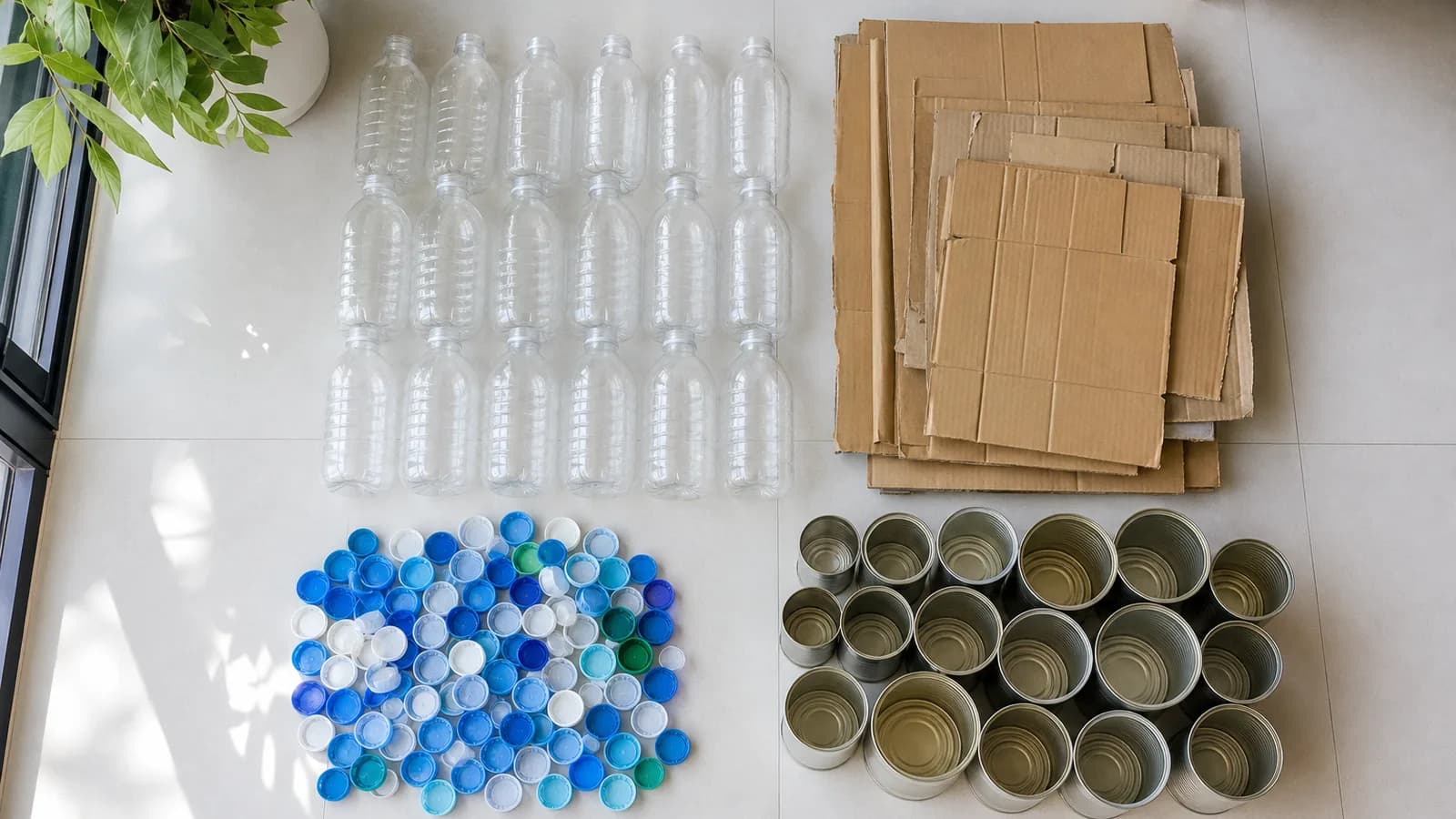
Most people who separate their plastics believe they have recycled them. It is a reasonable belief — it is what the bin is for — and it is where a long, mostly invisible process begins rather than ends. Whether anything is actually recycled depends on collection, sorting, contamination, the market value of the material that week, and whether a facility exists that can process that particular plastic at all.
The global number that comes out the other end of all that is smaller than almost anyone expects.
The number
The OECD's Global Plastics Outlook, which traced the full lifecycle of plastics worldwide, found that after accounting for losses during processing, only about 9% of plastic waste is ultimately recycled. Roughly 19% is incinerated, close to half goes to sanitary landfill, and the remaining fifth or so ends up in uncontrolled dumpsites, is burned in the open, or leaks into the environment.
The gap between what is collected and what is recycled is the part worth sitting with. Around 15% of plastic waste is collected for recycling — but roughly 40% of that is discarded as residue during processing. Contamination, mixed materials, labels, caps of a different polymer, food residue: each one moves a piece of plastic from the recycled column to the discarded one.
Why the figure is so low
Not because people are careless. Because of what plastic is.
- There is no such thing as "plastic" in the singular. There are many polymers that cannot be melted together, and sorting them is difficult, expensive and imperfect.
- Recycling degrades the material. Most plastic loses quality each cycle, so it moves down a ladder of uses rather than round a loop, and the ladder ends.
- New plastic is cheap. Recycled material has to compete on price with virgin plastic made from oil, and often loses.
- Small and mixed items lose. Caps, films, sachets, multi-layer packaging — the things a household produces most of are the hardest things to recycle.
This is not an argument for giving up on recycling. It is an argument for treating it as the last step in the sequence rather than the first — which is exactly the order the waste hierarchy has always put it in, and exactly the order most household habits reverse. The steps above it are duller and more effective: buying less, and choosing things that outlast their replacements.
What that means for a household
If only a small fraction of what leaves your house is genuinely recycled, then the decision that matters most is the one made before anything enters the house. That is uncomfortable, because it is also the harder decision — but it is the only one a household fully controls.

The honest caveat
One household's packaging is a rounding error against global plastic production, and anyone telling you otherwise is selling something. The reason to act is not that your bottles will move the global figure. It is that the decision is available to you, it is cheap or free, and it usually turns out to be the more convenient arrangement anyway once the switch is made.
Where households can compare arrangements directly — delivered containers against a system that makes water at the tap — the packaging arithmetic is set out in refilling stations and home systems. The everyday version, with no purchase involved, is in simple ways to reduce plastic bottles at home.
Sources
Filed under
- Sustainable Living
- plastic waste
- recycling
- household waste
- sustainability
- packaging