
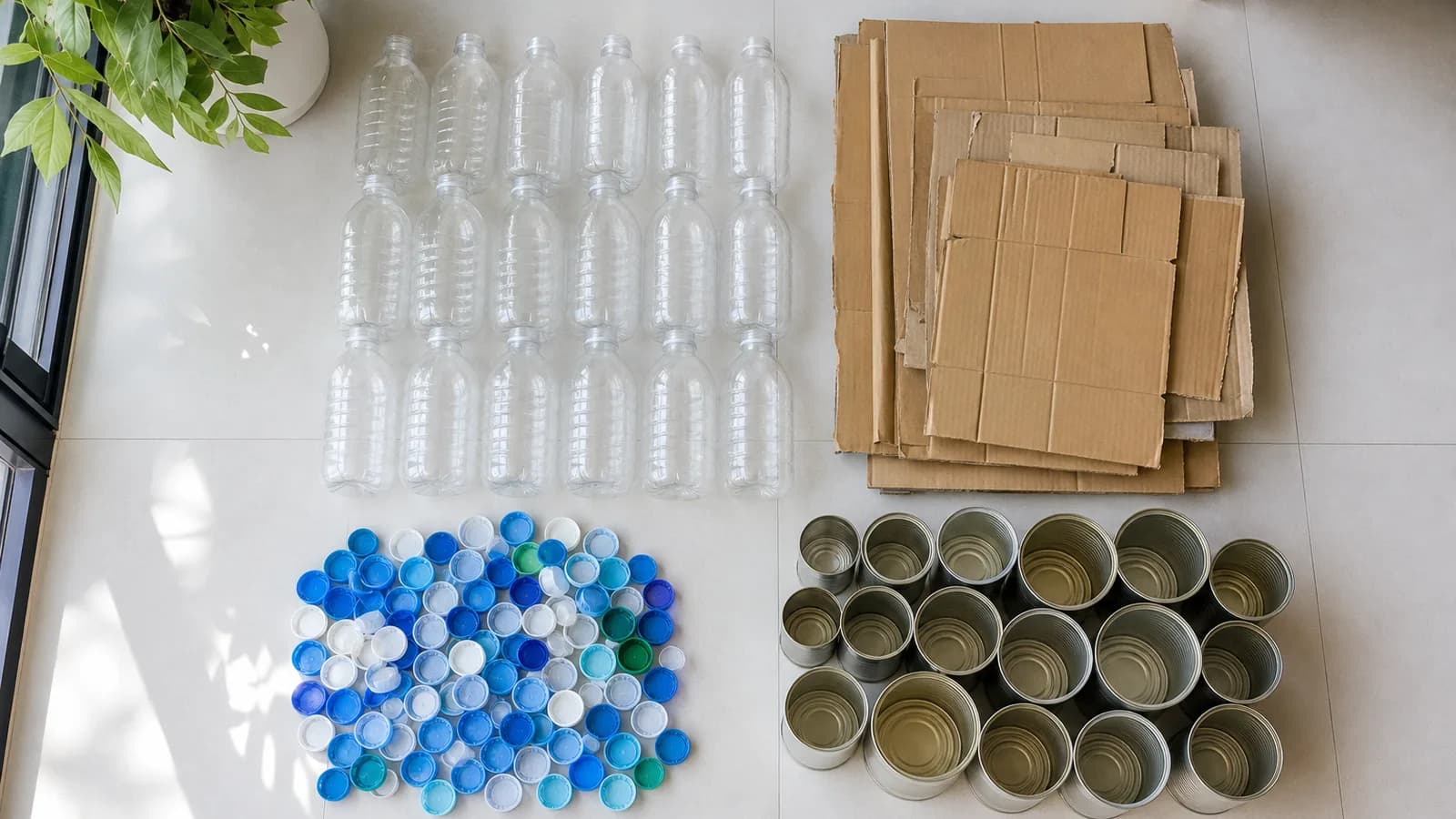
Ask a household how much plastic it throws away in a week and you will get a number. Ask it to count for seven days and you will get a different one, usually larger, and almost always in the same category: the recurring purchase nobody thinks of as a decision.
That gap is the entire value of a waste audit. It is not an exercise in guilt and it does not require buying anything. It takes a week, a pen, and a willingness to look.
Why guessing fails in a predictable direction
We remember decisions, and we forget routines. The case of water bought during a trip out, the sachet used every morning, the caps and seals — none of these register as choices, so none of them are in the estimate. What we do remember is the occasional big item, which is why people overestimate their cardboard and underestimate their plastic.
The correction is not a better estimate. It is a count.
The method, in full
- Pick an ordinary week. Not a fiesta week, not a week away. The point is the baseline, not the best case.
- Put a sheet of paper on the fridge. Not an app. The friction of opening an app is exactly the friction that ends audits on day three.
- Write five columns: plastic bottles and containers, sachets and film, paper and card, glass and metal, food waste.
- Everyone marks a tally when they throw something out. One stroke per item. No weighing, no photography, no judgement at the point of recording.
- On day seven, total the columns and — this is the part that matters — write beside each one where the item came from: delivered, bought in store, bought while out, given.
That last column is what converts a pile of numbers into a decision. Waste that arrives through a recurring channel can be changed once and stay changed. Waste that arrives ad hoc needs a habit, which is much harder.
What households usually find
Three results come up again and again, and none of them is a surprise once seen.
None of these findings requires a purchase to act on. Two of them require a change in shopping, and one — the water line — is the one households can restructure completely, which is why it tends to be where the audit leads. The packaging arithmetic for that particular decision is in refilling stations and home systems.
What to do with the result
Resist the urge to change everything. A waste audit produces a list, and a list produces paralysis. Take the largest recurring line and change only that, then leave it alone for a month.
The reason is practical rather than philosophical: recurring lines stay changed without effort once restructured, while ad hoc lines need attention every week. Fixing the one that stays fixed buys you the attention to work on the others later.
And keep the sheet. Repeating the count in six months is the only honest way to know whether anything actually changed — memory is no better at measuring improvement than it was at measuring the baseline.
The broader point
The reason to start with counting rather than recycling is that most plastic is not recycled — globally, after processing losses, only about 9% of it, according to the OECD. What a household actually controls is what comes in, and you cannot manage that until you have looked at it.
The full picture of where plastic ends up is in the 9% problem. The practical, no-purchase version of acting on an audit is in simple ways to reduce plastic bottles at home.
Sources
Filed under
- Sustainable Living
- waste audit
- household waste
- recycling
- packaging
- sustainable habits