Ask a household what their water machine does and you will usually get one answer covering two separate processes. That conflation is understandable — most machines in this category do both, in one housing, behind one price — but it leads to a specific and expensive mistake: buying an ionizer to solve a filtration problem, or assuming a filter has done something it never claimed to.
The two jobs are worth separating in your head before you spend anything.
What filtration does
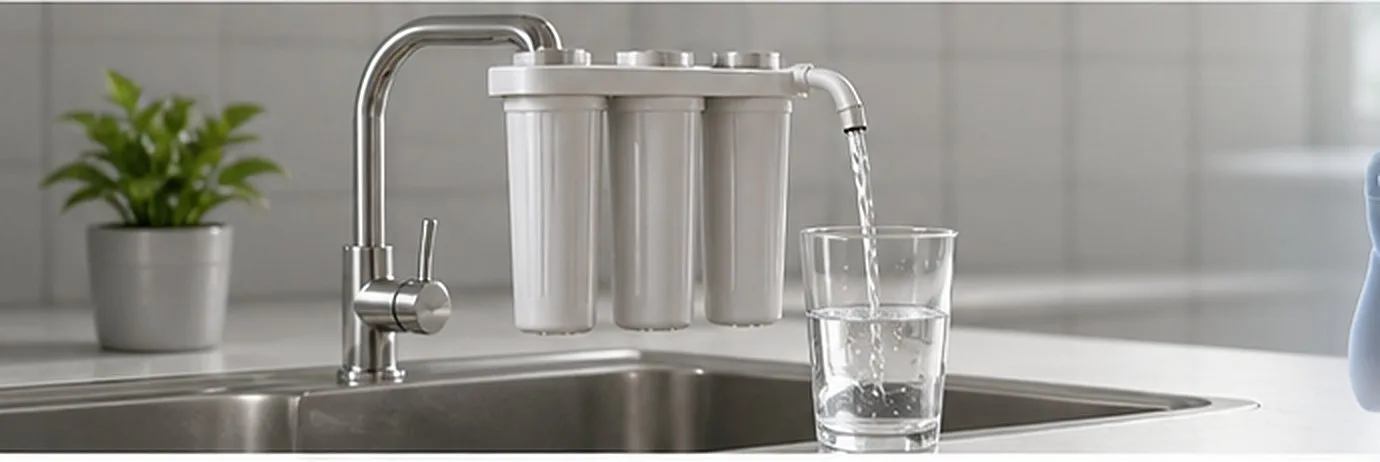
Filtration removes things from water. Which things depends entirely on the filter: a sediment filter takes out particles, activated carbon reduces chlorine and many organic compounds and improves taste and odour, and finer technologies remove progressively smaller things at progressively higher cost and, often, lower flow.
The important discipline here is specificity. A filter that reduces chlorine is not thereby doing anything about hardness. One that improves taste is not necessarily removing anything the regulators care about. The US EPA maintains the list of contaminants that are actually regulated in drinking water, and any serious claim about filtration should be readable against a list like it: this filter, this contaminant, this reduction.
What ionization does
Ionization does not remove anything. It passes already-filtered water across charged plates and splits it into two streams — one alkaline and carrying dissolved hydrogen, one acidic — by redistributing ions that were in the water to begin with. The full mechanism is in electrolysis, explained without the jargon.
So ionization changes properties of the water: pH, oxidation-reduction potential, dissolved hydrogen. It does not change what is dissolved in it in the sense of taking anything out. If your source water has a contaminant problem, electrolysis is not the answer to it — and a machine that ionizes without filtering first would simply be electrifying the problem.
This is why every credible ionizer is sold with a filter in front of the plates. The filter is not an accessory to the ionizer. It is the part doing the work most households actually care about.
Why the distinction matters when you are buying
None of that is an argument against buying a combined machine. It is an argument for knowing which half you are paying for, and for being able to say which half solves your particular problem. Ask a seller what the machine removes, what it adds, and what proves either.

Start with your own water, not with a machine
The order most households use is backwards. They choose a machine, then discover what their water is like. Reversing it costs nothing.
- Describe the actual complaint. Taste? Smell? Cloudiness? Scale on the kettle? Or simply the cost and hassle of delivered containers? Each points somewhere different.
- Find out what your supply is. Municipal water, a deep well and a subdivision system are three different starting points, and the last two vary enormously.
- Test on site. A demonstration on your own tap tells you more than any brochure. Ask for it before, not after, the pitch.
- Then look at machines. With the problem defined, the specification sheet stops being a wall of numbers and becomes a short list of relevant ones.
If you only remember one thing
Filtration is about what is in the water. Ionization is about what the water is like. A machine can do both, but no amount of the second substitutes for the first — and the household questions they answer are not the same question.
If the cost side is what you are weighing, hydrogen water vs bottled water works through what a home system is really being compared against. If you want the current systems side by side, the comparison lays out plates, flow rate and filter life together.
Sources
Filed under
- Water Technology
- water filter
- ionization
- filtration
- water quality
- buying guide