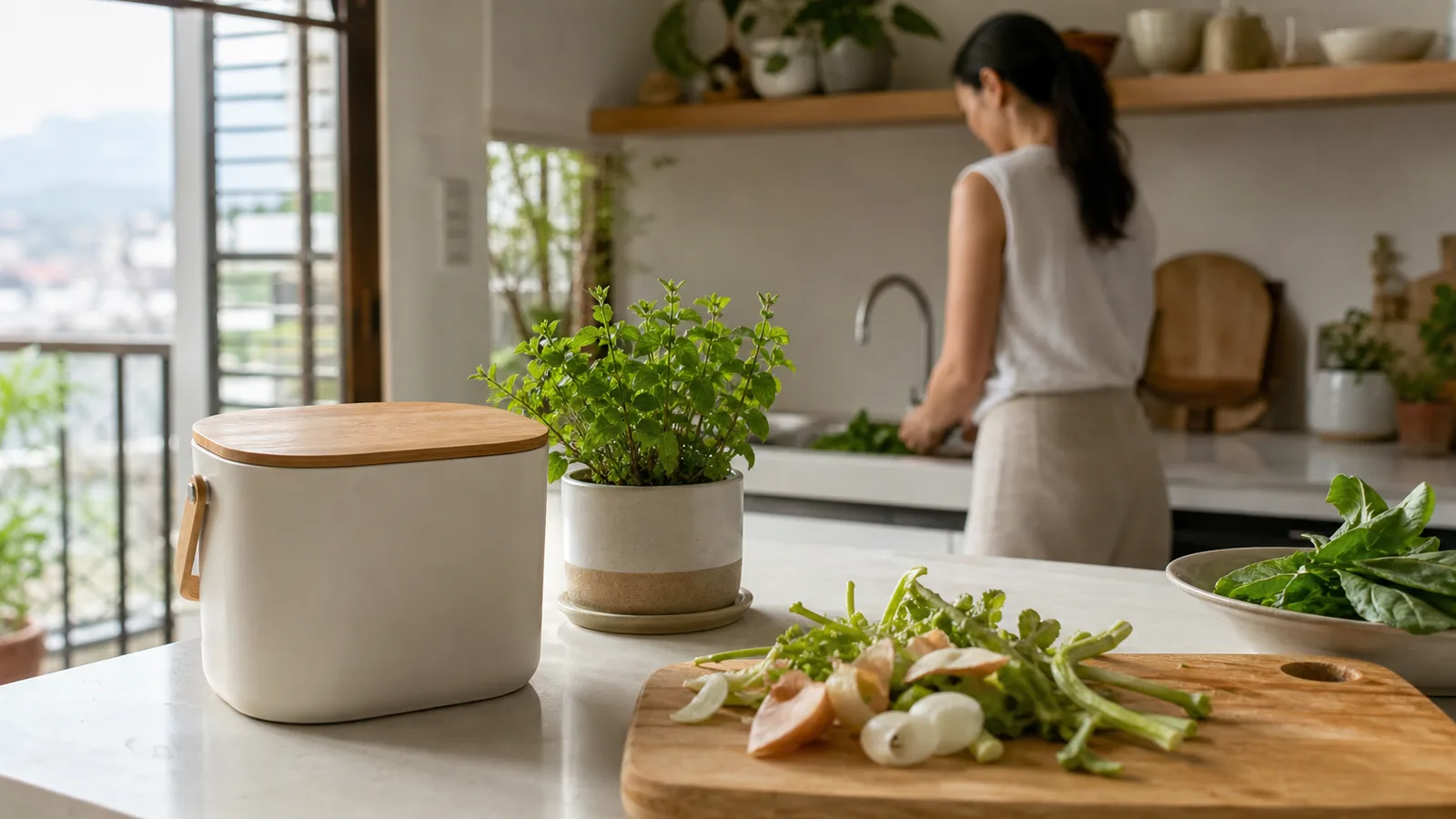
Do a household waste audit and food waste usually turns out to be the biggest line by weight. It is also the one most people conclude they can do nothing about, because the standard answer is a compost heap and a condo has no ground to put one on.
There are two methods that genuinely work indoors, one that does not, and an honest problem at the end about what to do with the result.
The two that work indoors
| Bokashi | Worm bin (vermicomposting) | |
|---|---|---|
| What it is | Fermentation in a sealed bucket using inoculated bran | A contained colony of composting worms eating scraps |
| Smell | Sealed; a sour pickled smell when opened | Should smell of earth. Anything else means something is wrong |
| Accepts | Almost everything, including cooked food, meat and dairy | Fruit and vegetable scraps only; no meat, dairy or oil |
| Speed | Two weeks to ferment, then it still needs burying or finishing | Continuous once established |
| Output | Pre-compost that must be buried, plus a liquid to dilute | Finished compost and a liquid, both usable directly |
| Effort | Low; add scraps, add bran, close | Moderate; it is a small livestock arrangement |
The method that does not work indoors is open-air composting. It needs volume, airflow and ground contact, and attempting it in a container on a balcony in this climate produces smell, flies and, in the wet months, a mosquito problem — the one covered under rainwater and its household uses.
The climate variable
Most composting guidance is written for temperate homes and understates what heat does. At 30°C and high humidity everything moves faster: fermentation, decomposition, and every failure mode.
The honest problem: what to do with the output
This is where condo composting usually stalls, and no guide mentions it. Both methods produce material that has to go somewhere, and a household with three potted plants will produce more compost than it can use within a couple of months.
Options that actually work: a building garden or landscaping team that will take it, a neighbour or relative with a garden, a community garden, or a local barangay programme. Arrange one before starting rather than discovering the problem with a full bucket in a small kitchen.
The step before composting
Composting handles food waste after it exists. Producing less of it is cheaper, easier and available to every household regardless of space — and in most audits it is a planning problem rather than a storage one: buying for a week that did not happen, and forgetting what is at the back of the fridge. Food is also one of the clearest places where the greener choice and the cheaper one genuinely overlap.
Count it first. The method is in a one-week household waste audit, and for most households the result makes the priority obvious.
General household information. Check your building's rules before setting up any composting system, and follow local waste regulations.
Sources
Filed under
- Sustainable Living
- composting
- food waste
- condo
- small space
- sustainable living