
Eight glasses a day is one of the most repeated pieces of health advice in the world, and almost nobody can say where it came from. It turns out to be a reasonable rule of thumb attached to a shaky origin story — and, more usefully, a number that was never meant to apply to everyone equally.
This is a practical guide to the question rather than a definitive answer, because a definitive answer does not exist. What does exist is a sensible range, a short list of things that genuinely move your own number, and a couple of signals that are far more useful than counting.
Where “eight glasses a day” came from
The figure is usually traced to mid-twentieth-century dietary guidance suggesting adults need roughly 2.5 litres of water a day. The part that got lost in transmission was the very next line: most of that comes from prepared food. The advice was never that you must drink two and a half litres on top of everything you eat.
It survived anyway, because it is memorable, harmless and roughly the right order of magnitude. That is a decent reason to keep using it as a rough target — and a bad reason to treat it as a rule you are failing.
What the guidance actually says
Most national health bodies land in a similar place: adult men need somewhere around 2.5 to 3.7 litres of total water a day, and adult women around 2 to 2.7 litres, with the ranges deliberately wide. Roughly a fifth to a third of that arrives in what you eat rather than what you drink, so the drinking portion for most adults lands somewhere between six and ten glasses.
The ranges are wide because the honest answer is that requirements vary enormously between people and between days. A guideline that gave everyone one number would be precise and wrong.
What genuinely changes your number
Most of the variation comes from a short list, and in the Philippines the first item on it does a lot of the work.
- Heat and humidity. In a tropical climate you lose more through sweat all year round, not only when exercising. This is the single biggest reason a European guideline understates local needs.
- Activity. Anything that makes you sweat raises the number, and the increase lasts beyond the activity itself.
- Body size. Larger bodies need more. The guidelines are averages across a wide population.
- Air conditioning. Cooled air is dry air, and a day spent in an air-conditioned office increases losses you never notice because you never feel hot.
- Pregnancy and breastfeeding. Both raise requirements meaningfully; this is a question for your doctor or midwife rather than an article.
- Illness. Fever, vomiting and diarrhoea all increase losses sharply, and this is where dehydration genuinely becomes a medical matter.
- Coffee, tea and alcohol. Caffeinated drinks still contribute water on balance, despite the folklore. Alcohol is the real outlier — it increases fluid loss.
Better signals than counting
Counting glasses is tedious and most people abandon it within a fortnight. The body already provides two reasonable indicators, and both are free. Neither is precise, and knowing how imprecise each signal is turns out to be the useful part.
The first is thirst. It is a genuinely good signal for most healthy adults going about a normal day. The common claim that thirst means you are already dehydrated overstates things — it means your body has noticed and is asking, which is precisely what it is meant to do. The exceptions matter, though: thirst becomes less reliable with age, and it lags badly during intense exercise or illness.
The second is urine colour. Pale straw suggests you are broadly fine; consistently dark suggests you could drink more. It is imprecise — vitamins, medication and some foods all change the colour — but as a rough daily check it is more useful than a tally.
When more is not better
It is worth saying plainly, because hydration advice tends to run in one direction only: drinking far more than you need is not a bonus. In rare cases — usually endurance athletes drinking heavily over several hours — very high intake can dilute blood sodium to a dangerous degree. It is uncommon, and it is not something a normal day at the office will produce.
Making it happen without tracking anything
Almost everyone who drinks too little knows they drink too little. The gap is never information; it is friction. The fix is to change what is convenient rather than to try harder.
- Attach it to something you already do. A glass with each meal and one when you get home is most of the way there without a single decision.
- Put it where you are. A jug on the desk or the counter you pass beats a dispenser in a corner of the kitchen.
- Make it the visible option. What is in front of people in the fridge is what gets drunk.
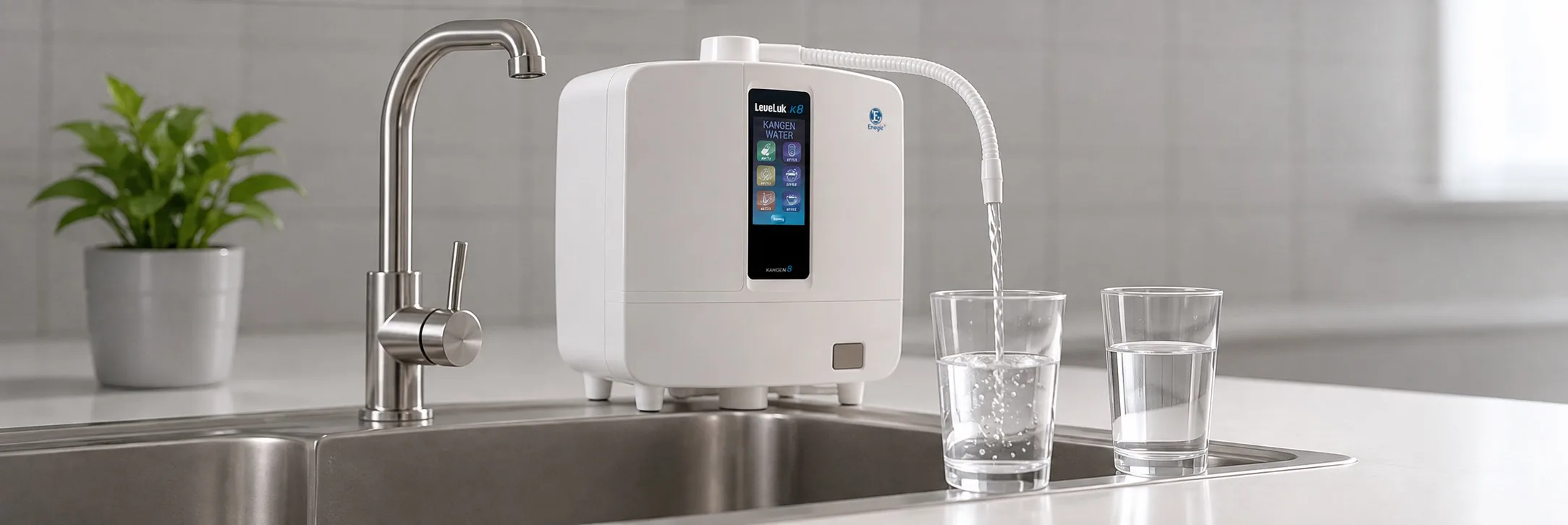
- Fix the taste problem. If your household avoids tap water because of how it tastes, that is a water-quality issue, not a discipline issue — and it is fixable.
- Start the day with one. The easiest glass to remember is the first one.
Does the type of water matter?
Less than the amount, and much less than the marketing suggests. Plain, clean water does the job. Mineral content, pH and dissolved gases are all real properties with real differences, and some of them — hydrogen-rich water among them — are genuinely being studied, but none of them change the basic arithmetic of how much you need. The two that get blurred together most often are pH and dissolved hydrogen, which are not the same claim.
Where water quality does matter for intake is indirect and easy to underestimate: people drink more of water they enjoy. If better-tasting water at home means your family reaches for it instead of a soft drink, that is a bigger effect than any property of the water itself. Why Hydrogen-Rich Water Matters covers what is and is not established about the water category itself.
The short answer
Somewhere between six and ten glasses for most adults, more in this climate, more again if you are active or unwell — and you do not need to count any of it. Drink to thirst, glance at the colour, keep water where you actually are, and make it the easiest thing in the house to reach for.
If the reason your household drinks less water than it should is that it comes in bottles that keep running out, Simple Ways to Reduce Plastic Bottles at Home tackles that problem directly.
Wellness Insights publishes general educational content about hydration, water quality and healthy-home living. It is not medical advice, and nothing here is intended to diagnose, treat or prevent any condition. If you have a health condition, are pregnant, or have been given a fluid target by a clinician, follow their guidance rather than general advice.
Sources
- European Food Safety Authority — Dietary reference values for water.
- EFSA Panel on Dietetic Products, Nutrition and Allergies (2010). Scientific Opinion on Dietary Reference Values for water.
- Philippine Statistics Authority — Majority of Families Have Access to Improved Source of Drinking Water (2022 Annual Poverty Indicators Survey).
Filed under
- Wellness
- hydration
- daily habits
- water intake
- routines
- family wellness