
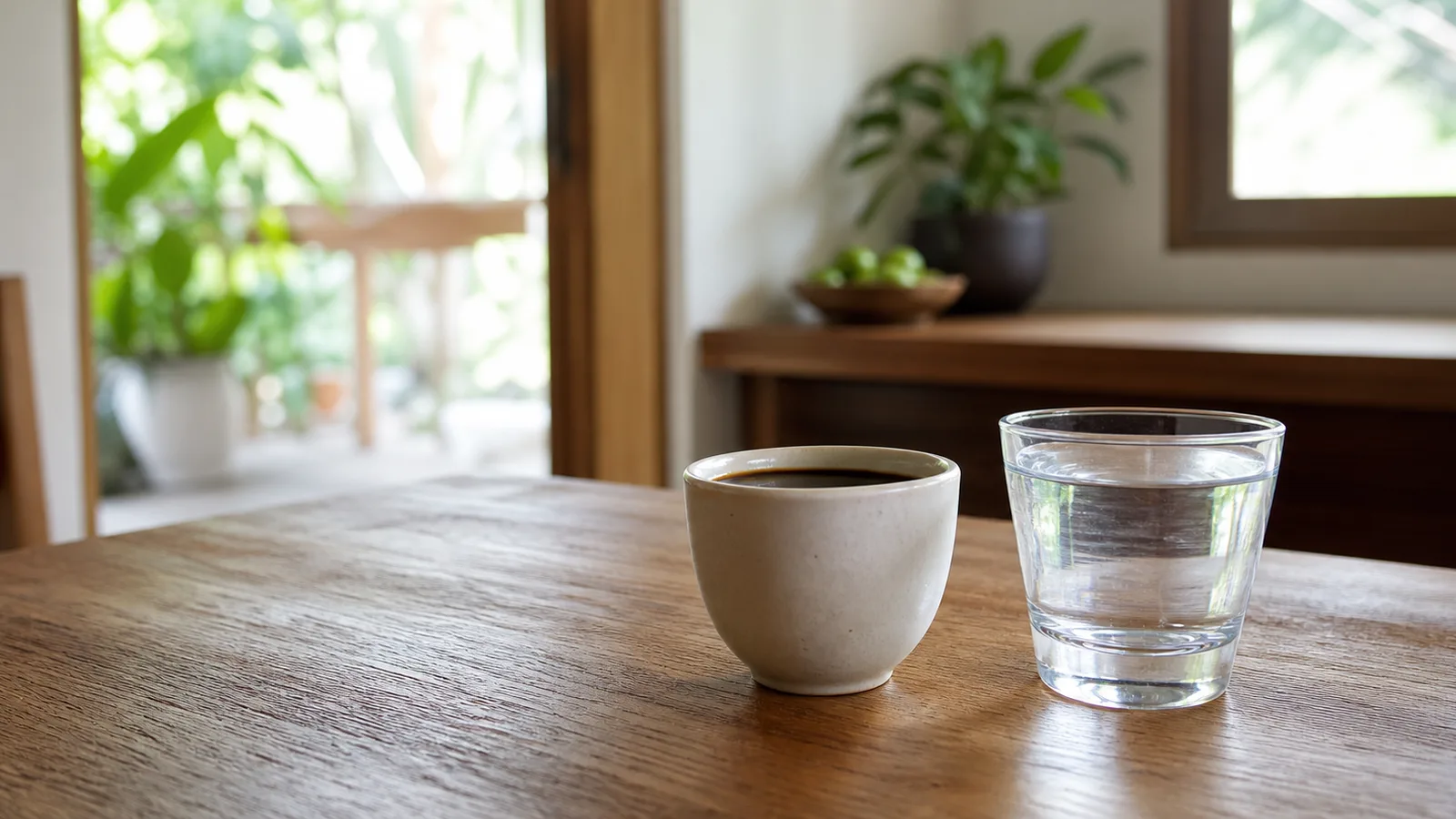
Somewhere along the way, "coffee dehydrates you" became one of those facts everyone knows. It is repeated in offices, printed in wellness guides, and used to explain away a headache at 3pm. It is also, in the form most people repeat it, not supported by the research.
The accurate version is more useful, and it does not require giving anything up.
Where the idea came from
It is not invented. Caffeine does have a mild diuretic effect — it can increase urine output, particularly in people who do not normally consume it, and particularly at high doses taken in one go.
The leap happens between that observation and the conclusion. A drink that slightly increases urine output is not thereby a drink that leaves you with less fluid than you started with — because the drink itself is mostly water. A 200 ml cup of coffee delivers roughly 200 ml of fluid, and the question is only whether the caffeine causes you to lose more than that.
What happens when it is actually measured
A 2014 study published in PLOS ONE set out to test it directly in ordinary conditions. Fifty healthy men who habitually drank coffee were followed through two three-day periods in a counterbalanced cross-over design: in one they drank four 200 ml mugs of coffee a day, in the other the same volume of water.
The researchers measured total body water, urine volume and blood markers of hydration. They found no meaningful differences between the coffee and the water trials, and concluded that coffee consumed in moderation by habituated drinkers provides hydrating qualities similar to water.
So does it count?
For a habitual coffee drinker at ordinary intake: yes, the fluid counts. The major dietary reference values are calculated on total water — everything you drink plus the water in what you eat — and coffee is part of everything you drink.
Two caveats worth keeping, because they are where the old advice retains some sense:
- If you rarely drink coffee, an unusual dose is more likely to produce a noticeable diuretic effect than it would in a regular drinker.
- Coffee is not a substitute for water in the heat. Someone working outdoors in a Philippine afternoon needs volume, and four cups of coffee is not how you get it comfortably.
Neither of those makes coffee a hydration problem. They make it one contributor among several, which is what it always was.
What actually matters more
The coffee question absorbs far more attention than it deserves, usually at the expense of the thing that actually determines a household's intake: how easy the water is to reach.
People who drink enough are rarely the ones who counted carefully. They are the ones for whom a glass of decent water is within arm's reach and requires no decision — which is a point about kitchens rather than about caffeine, and one we make at length in how much water should you drink each day.
The rest of what counts sits in the same cluster. Roughly a fifth to a third of most people's fluid arrives as food rather than drink — how much water comes from food. The belief that coffee dehydrates you is one of several that survive on repetition alone, collected in hydration myths that refuse to die. And if you brew seriously, the water you brew with is the largest ingredient in the cup: coffee, tea and the water you brew with.
This is general information, not medical or dietary advice. Anyone advised by a doctor to limit caffeine or manage fluid intake should follow that guidance rather than a general article.
One more thing, since it is a water publication
If you make coffee at home, the water is most of what is in the cup — brewed coffee is around 98% water. Whatever your water tastes of, your coffee tastes of. Households that change their water supply usually notice it in the coffee before they notice it anywhere else.
That is a taste observation rather than a health one, and it is the honest reason to care about brewing water.
Sources
Filed under
- Hydration
- coffee
- caffeine
- daily water intake
- hydration myths
- everyday habits