Every product in this category is bounded by the same piece of physics: at ordinary pressure, water saturates at roughly 1.6 mg of dissolved hydrogen per litre. No technology beats that ceiling, so nobody is competing on how much hydrogen they can theoretically produce.
What they actually differ on is how much of it is still there when you drink it, what it costs to keep doing, and what it asks of your kitchen.
1. Magnesium tablets
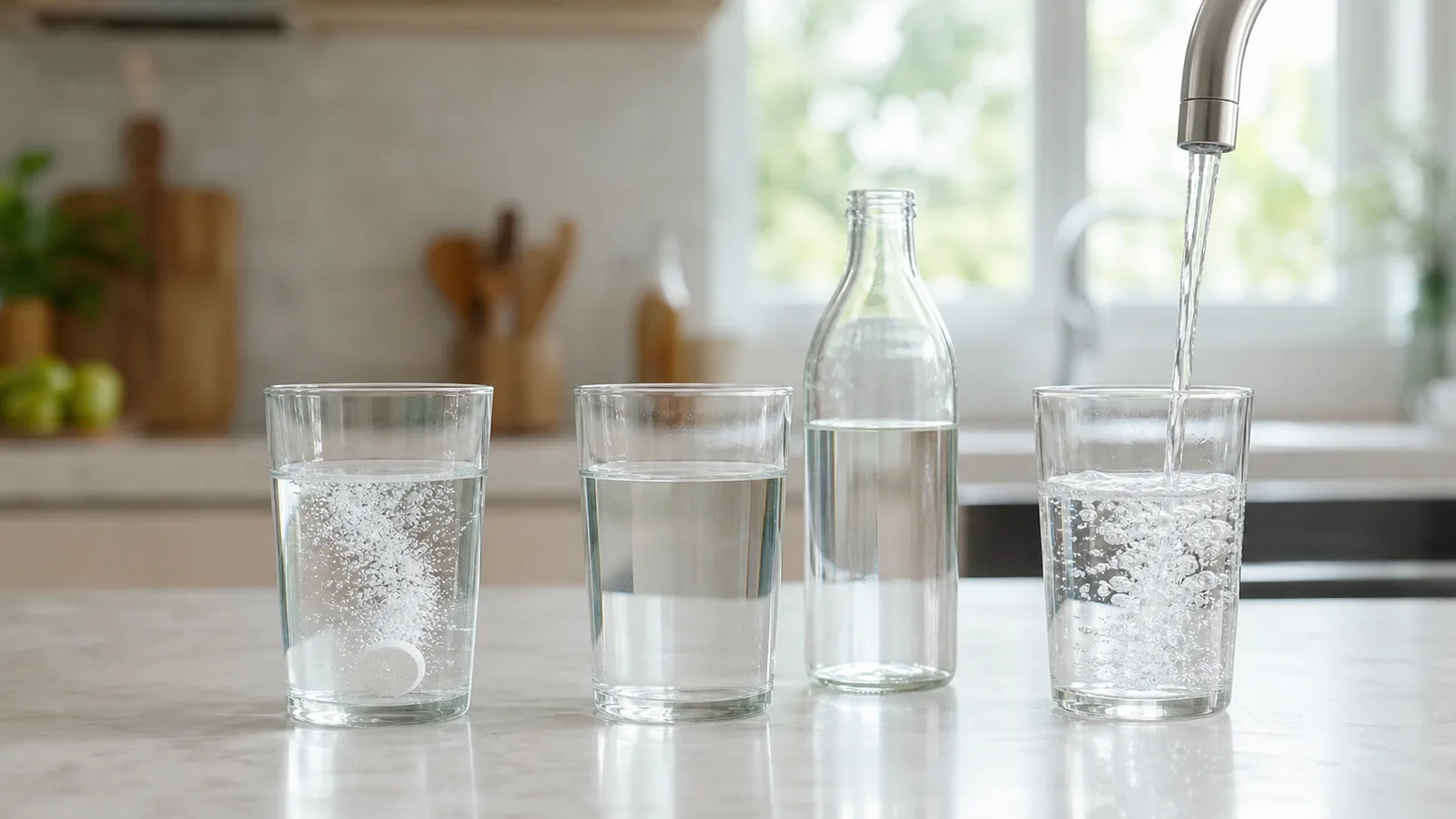
A tablet dropped into a glass reacts with the water and releases hydrogen gas over a minute or two. The appeal is obvious: no installation, no plumbing, works anywhere, cheap to try.
Best suited to travel, to trying the category before committing, or to someone who wants hydrogen water occasionally rather than daily.
2. Pre-bottled hydrogen water
Water infused at a factory, sealed and shipped. The most convenient format to buy and the most structurally difficult one to deliver, for a reason covered at length in why the number fades so fast: hydrogen is the smallest molecule there is, and it permeates ordinary plastic.
That is why serious products in this format use aluminium pouches or cans rather than clear PET bottles. A hydrogen water in a standard plastic bottle that has spent weeks in a warehouse is, on this specific measure, unlikely to be delivering what its label describes.
It is also the most expensive route per litre by a wide margin, and it reintroduces exactly the packaging the category's own sustainability pitch objects to.
3. Electrolysis at the tap
A home ionizer filters incoming water, passes it across electrode plates and applies a current, producing a hydrogen-rich stream and an acidic one. The water is drawn and drunk immediately — the mechanism is set out in electrolysis, explained without the jargon.
The honest framing is that this does not solve the storage problem; it avoids having one. Nothing is stored, so nothing decays. That is a smaller claim than the marketing usually makes and a more defensible one.
The costs are the mirror image of tablets: a large amount up front, then filters, against a per-glass cost of essentially nothing. It also asks the most of the kitchen — counter space, a water connection, drainage, a socket — and whether that trade suits your household is worked through in who should not bother.
Side by side
| Tablets | Pre-bottled | Home ionizer | |
|---|---|---|---|
| Freshness at drinking | Good — made in the glass | Depends entirely on packaging and time | Good — made at the tap |
| Cost structure | Per glass, ongoing | Per bottle, highest per litre | Upfront, then filters |
| Packaging produced | Tablet packaging | A bottle every time | None once installed |
| Kitchen requirements | None | Storage space | Counter, water, drain, socket |
| Suits | Travel, occasional use | Convenience, trying it | Daily household use |
The common thread
Whichever route you consider, the useful questions are the same three: what concentration, measured when, and at what cost per litre over a year. Every honest seller in this category can answer all three; the answers differ, which is the point of asking.
This article compares product formats. It makes no health claim — the state of that research is set out separately in why hydrogen-rich water matters.
Sources
Filed under
- Hydrogen Water
- hydrogen water tablets
- bottled hydrogen water
- water ionizer
- comparison
- buying guide